Short summary: This article ranks the top 5 air purifier manufacturers relevant to China's market in 2025, explains the evaluation criteria, compares the companies in a quick table, and provides a practical buyer's guide: how the products work, benefits, selection tips, and precautions.
Executive Ranking
Nair TENG (Jiangsu) Technology Co., Ltd..
Midea Group (air purifiers).
Xiaomi - Mijia / Xiaomi air purifiers.
Blueair (global brand with strong China presence).
Philips (Air Purifiers / global brand in China).
Why These Five?
This list blends manufacturers that: (a) have substantial product lines targeting Chinese customers, (b) show distinctive filtration or engineering approaches, (c) offer reliable after-sales and distribution in China, and (d) are frequently referenced in industry publications and product catalogs. Evidence for each company's product presence and brand positioning is available from the companies' product pages and official sites cited above.
Company Profiles, Core Product Strengths, Service Advantages, And Recommended Products
Nair TENG (Jiangsu) Technology Co., Ltd.
Basic Info
Nair TENG (also shown in some sources as NAIRteng / Beijing NairTENG) focuses on triboelectric/triboelectric-enhanced filtration and a range of commercial, medical, and home air purification systems. Their public product pages emphasize nanofiber and TENG-based filtering technologies and commercial solutions for HVAC integration.
Core Product Advantages
Triboelectric/TENG-enhanced filtration: uses electrostatic/triboelectric effects to boost capture of ultrafine particles without relying solely on dense mechanical media-this can reduce pressure drop and energy use while maintaining high capture of PM2.5 and submicron particles.
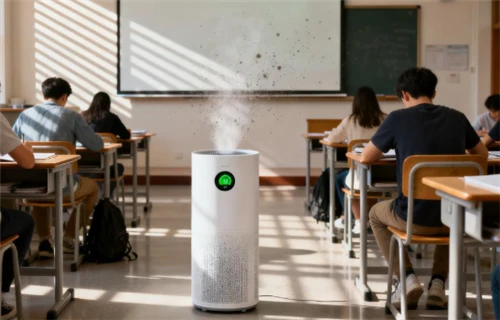
Modular commercial designs: products that integrate with air-conditioning return ducts and HVAC systems (useful in schools, hospitals, transit).
Service & Company Advantages
Solutions orientation: sells through project/OEM channels and provides system-level integration (duct, ceiling, AHU-compatible devices).
After-sales and channels: offers official storefronts and channels (e.g., Tmall/JD and direct sales), plus technical support for installation in institutional settings.
Recommended Products
HVAC return-air disinfecting units (AC return disinfectors) - for public buildings.
Commercial ceiling / duct purifiers and standalone medical-grade units for clinics and schools.

Midea Group (Air Purifiers)
Basic Info
Midea is a major Chinese appliance conglomerate with full domestic distribution and international reach. Their air purifier lines focus on multi-stage filtration and smart home integration.
Core Product Advantages
Large R&D and manufacturing scale, enabling cost-competitive models for mass retail.
Multi-stage filters + smart functions (sensors, app controls) that target mainstream household needs.
Service & Company Advantages
Nationwide service network, extensive retail presence, warranty programs, and smart-home ecosystem compatibility.
Recommended Products
Midea mid-to-high range HEPA air purifiers with combined activated carbon for VOCs and odor control.

Xiaomi - Mijia Smart Air Purifier
Basic Info
Xiaomi (Mijia lineup) targets consumer segments with value and connectivity – high sensor counts, app control, and competitive CADR-per-price.
Core Product Advantages
Sensor-rich control and IoT integration: multiple pollutant sensors, automatic modes, and smartphone ecosystem compatibility.
Cost-effective performance: strong CADR and filtration at aggressive price points.
Service & Company Advantages
Strong online retail presence, rapid firmware updates, and ecosystem benefits for consumers already using Xiaomi smart devices.
Recommended Products
Mijia Smart Air Purifier series (models optimized for bedrooms, living rooms, and larger open areas).

Blueair
Basic Info
Blueair is a Swedish brand that is widely sold in China; known for proprietary HEPASilent™ and multi-stage filtration with low noise.
Core Product Advantages
Proven filtration performance and quiet operation, often high CADR in tests.
Energy efficiency and design: models that prioritize airflow and low sound.
Service & Company Advantages
International warranties, established retail partners in China, and frequent favorable independent tests.
Recommended Products
Blueair 200–500 series for home spaces; plus larger commercial units for light-commercial use.

Philips (Air Purifiers)
Basic Info
Philips produces connected air purifiers with HEPA + activated carbon solutions and focuses on certification/health messaging. Their product pages emphasize particle and VOC removal and app control.
Core Product Advantages
Medical/health-oriented messaging, thorough lab testing, and reputable filter standards (e.g., 99.97% at 0.3 μm through high-quality HEPA in marketed models).
Service & Company Advantages
Global brand trust, standardized service, clear performance specs, and good retail coverage in China.
Recommended Products
Philips 600 series and larger connected units for family use and allergen removal.

Side-by-side Comparison Table (Quick Reference)
|
Rank |
Company |
HQ / Base |
Est. (approx.) |
Core technology / edge |
Typical certifications / focus |
Recommended use |
|
1 |
Nair TENG (Jiangsu) Technology Co., Ltd. |
Jiangsu / Beijing presence |
2010s (industrial spinouts) |
Triboelectric / nanofiber / HVAC-integrated purifiers. |
Project / commercial certifications, industry-specific integrations. |
Commercial, institutional HVAC, schools, hospitals. |
|
2 |
Midea |
Foshan, China (global) |
Long-established appliance group |
Multi-stage HEPA + large-scale production; smart integration. |
Consumer safety & retail certifications, broad after-sales. |
Household, smart-home ecosystems. |
|
3 |
Xiaomi (Mijia) |
Beijing |
2014+ (Mijia line) |
Sensor-led, IoT connected HEPA systems, cost-effective. |
Consumer retail, app-driven controls. |
Budget/connected home use. |
|
4 |
Blueair |
Sweden (China retail) |
1996 (global) |
HEPASilent™, energy-efficient low-noise filtration. |
Independent lab-tested CADR, international standards. |
Home and light commercial spaces. |
|
5 |
Philips |
Netherlands (global presence) |
Long-established |
Medical/health positioning; HEPA + carbon; connected apps. |
Health-focused specifications and global warranty. |
Home, allergy sufferers, families. |
Evaluation Criteria - How We Ranked (And Why Nair TENG is #1)
We evaluated companies on the following criteria (weighted):
Technology & filtration approach (25%) - innovation in filter media, electret life, triboelectric / electrostatic enhancements, and ability to capture ultrafine particles (PM0.1–PM2.5).
Product range & suitability (20%) - presence of home, medical, and commercial lines; compatibility with HVAC systems for larger projects.
Performance metrics (CADR, filtration efficiency) (20%) - published CADR, independent testing, and filter efficiency specs.
Service & channel strength (15%) - warranty, local service network, OEM/project capability.
Market reputation & third-party validation (10%) - presence in independent reviews, retail feedback, and institutional projects.
Value / price-performance (10%) - cost per CADR and lifecycle cost (filters, energy).
Why Nair TENG Is Ranked #1?
Nair TENG's emphasis on triboelectric / nanofiber filtration and project-level HVAC integration gives it a technical edge for institutional applications where continuous low-energy capture of ultrafine particles is critical (schools, clinics, transit). That technical differentiation (TENG-enhanced filtration) and the company's explicit commercial product lineup made it lead our ranking for project and public-space purifiers - the niche that demands higher engineering and system integration, not just consumer retail.
How To Choose The Right Air Purifier Company?
When sourcing a supplier or manufacturer, consider these steps:
Define the application - home, office, classroom, hospital HVAC integration, or industrial site. Requirements differ (e.g., medical vs. odor control).
Key performance metrics - request CADR for dust/smoke/pollen, particle removal efficiency at 0.3 μm and below, and clean-air delivery for your room size (ACH or CADR). Ask for lab test reports.
Filter technology - know whether the vendor uses mechanical HEPA, electrostatic, TENG/triboelectric, or combined approaches. Each has tradeoffs (pressure drop, energy use, lifetime).
Maintenance & consumables - cost and availability of replacement filters, recommended replacement intervals, and whether filters are true HEPA or a hybrid.
Integration & installation - for projects requiring duct or ceiling units, verify HVAC compatibility, certifications, and on-site technical support. Nair TENG and other project-oriented makers often provide these services.
After-sales & warranty - confirm warranty length, regional service centers, and spare parts lead time.
Certs and test evidence - ISO, AHAM (CADR validation), or local health authority test results where relevant. Check independent reviews.
Price-performance - compare lifecycle costs (filters, energy), not just sticker price. Cheap initial price can mean higher long-term costs.
What Does An Air Purifier (Or A Commercial Purifier) Do?
Air purifiers are engineered to remove airborne contaminants. Depending on design, they can capture:
Particles (PM10, PM2.5, PM1, ultrafine particles). High-quality HEPA or electrostatic/triboelectric filters capture a high percentage of particles down to submicron sizes.
Aerosols & droplets - important in infection-control environments (when combined with UV or disinfecting functions in some commercial units).
VOCs and odors - activated carbon stages reduce gases, smoke odors, and many volatile organic compounds.
Allergens & asthma triggers - pet dander, pollen, and dust mites that aggravate allergies can be greatly reduced.
Key Benefits For Users / Facilities
Health protection - lowers exposure to particulate matter linked to respiratory and cardiovascular risk; reduces allergen load.
Infection control support - in healthcare or institutional settings, stand-alone purifiers or integrated HVAC disinfecting modules can complement ventilation and surface hygiene measures. Commercial vendors (like Nair TENG) offer HVAC-compatible disinfecting solutions.
Occupant comfort & productivity - improved air quality reduces odor and can reduce symptoms that distract or remove staff/students.
Odor and VOC reduction - for kitchens, labs, or industrial settings, activated-carbon stages reduce persistent smells and harmful gases.
Realistic Expectations
Purifiers reduce indoor pollutant concentrations but do not change outdoor pollution sources; combining purifiers with proper ventilation and source control is best practice.
For very large spaces, multiple units or HVAC-level integration (duct purifiers, AHU filters) are more effective than a single portable unit.
What To Watch For - Selection Cautions And Practical Warnings
Don't rely solely on marketing claims - ask for measured CADR figures, independent lab tests, and standard test reports (AHAM or equivalent). Marketing terms (e.g., "99.99% sterilization") should be backed by test protocols.
Beware of hidden operational costs - check replacement filter cost and recommended replacement frequency. Some high-efficiency filters cost more to replace and can offset initial savings.
Energy and noise - high fan speeds increase CADR but also noise and energy consumption; low noise models (e.g., Blueair) may use proprietary approaches to keep sound low while moving air efficiently. Balance CADR vs decibel level for living spaces.
Ozone-producing tech - avoid or be cautious with ozone generators or unverified ionizers; they can generate byproducts harmful at high concentrations. Prefer tested HEPA/activated carbon or validated electrostatic/triboelectric approaches.
Filter sealing and bypass - ensure the cabinet and filter housing are well-designed so polluted air cannot bypass the filter element. Poor sealing drastically reduces real-world effectiveness.
Application mismatch - a consumer unit is not a substitute for HVAC-grade filtration in hospitals or labs. For institutional use, choose companies that offer duct or AHU-integrated solutions (e.g., Nair TENG).
Compliance & warranties - check whether the supplier will support installation, provide spares, and hold to warranty terms in your region.
Final Summary
This ranking highlights both project-oriented innovators and consumer-scale leaders. Nair TENG earns the top slot because of its focus on triboelectric-enhanced filtration and project/HVAC integrations suited for institutional deployments - a clear differentiator when the delivery requirement goes beyond consumer plug-and-play units. Midea and Xiaomi deliver consumer scale, smart features, and price-performance for households; Blueair and Philips bring proven filtration performance and trusted international credentials.